


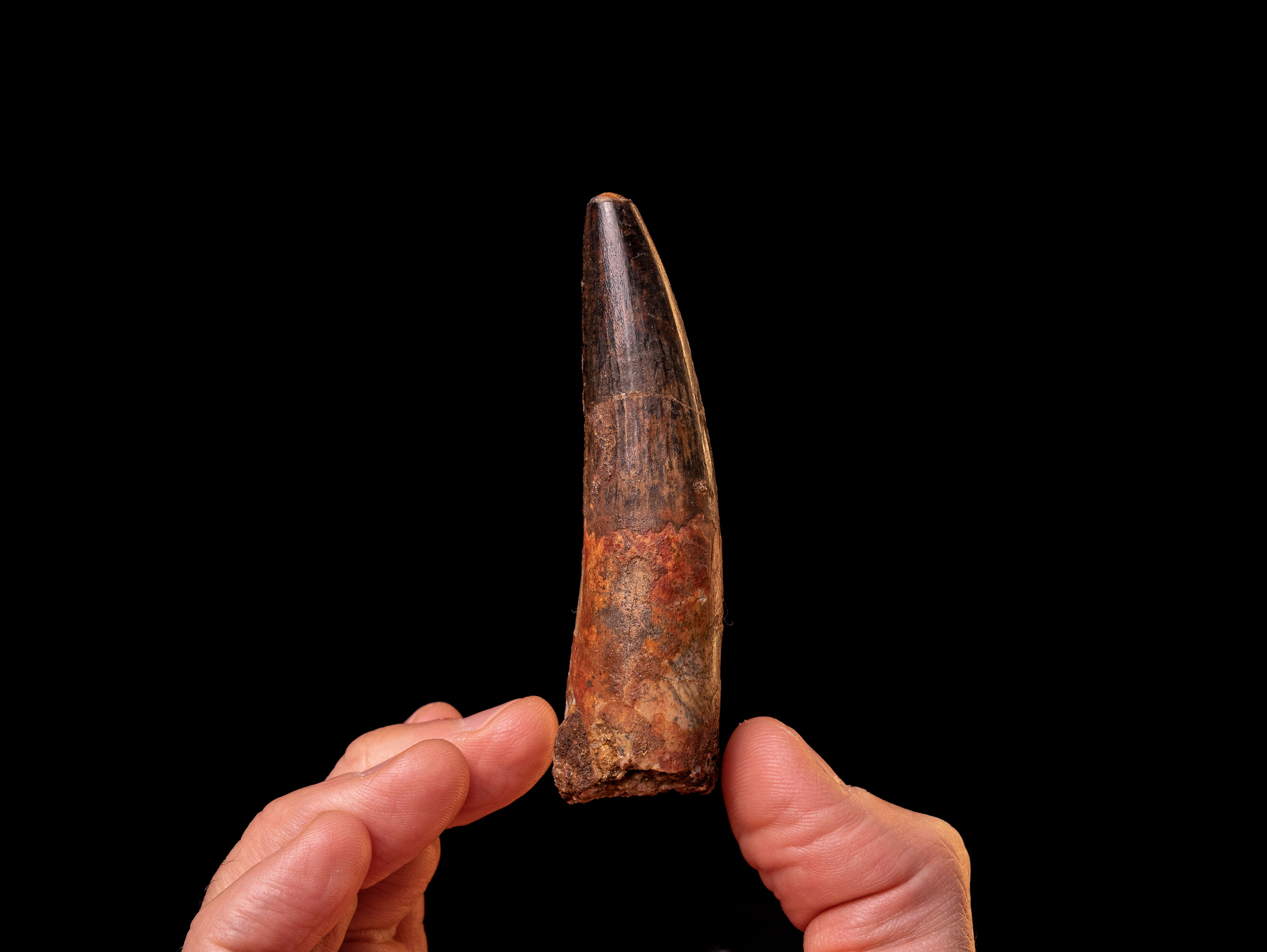

Spinosaurus aegyptiacus (Stromer, 1915)
Era: Mesozoic
Period: Cretaceous
Age: Cenomanian-Turonian (100.5 - 89.8 Ma)
Formation: Ifezouane (Red sand)
Origin: Kem-Kem valley,  Begaa, near of Taouz
Region: Drâa-Tafilalet
Province: Errachidía, Morocco
Coordinates: 30°53'53.7"N 3°51'48.6"W
Measurements: 85 x 23 x 20 mm / 3.35" x 0.91" x 0.79"
Weight: 36.6 g / 1.29 oz
Description: A subadult carnivorous dinosaur tooth in very good condition. An excellent opportunity to add an authentic Spinosaurus aegyptiacus tooth to your collection.


Information: The Kem Kem Beds are located in southeastern Morocco, near the border with Algeria. They constitute one of the most important fossil assemblages of the African Cretaceous and are formed by a succession of fluvial and deltaic deposits accumulated between the Late Albian and the Cenomanian.
Contrary to popular belief, Kem Kem does not correspond to a single site or a single ecosystem. It is a geological group composed of several sedimentary formations that represent different environments and periods in time. Among these, the Ifezouane and Gara Sbaa formations stand out, constituting the lower part of the sequence, as well as the Aoufous and Douira formations, which represent more recent levels.


The fossils recovered at Kem Kem include an extraordinary diversity of vertebrates, including sharks, bony fish, coelacanths, turtles, crocodiles, pterosaurs, dinosaurs, and birds. Among the dinosaurs found at Kem Kem are some of the largest known terrestrial predators, such as Spinosaurus aegyptiacus and Carcharodontosaurus saharicus. However, not all the animals found there necessarily coexisted at the same time. Many come from different stratigraphic levels within the sedimentary sequence, which records several million years of geological history. Therefore, Kem Kem should be understood as an exceptional window into the ecosystems of Cretaceous Africa rather than as representing a single biological community.


Spinosaurus aegyptiacus was one of the most extraordinary predatory dinosaurs that inhabited North Africa during the Cretaceous. It belonged to the spinosaurid group, a family of theropods characterized by their elongated skulls, similar to those of crocodiles, and by their conical, serrated teeth, adapted for capturing slippery prey. Its name means "Egyptian spine lizard," referring to the long neural spines that formed a spectacular sail on its back.


The Kem Kem Beds have yielded some of the most important known remains of this unique predator. Thanks to discoveries made in Morocco over the past few decades, paleontologists have been able to reconstruct much of its anatomy and revise many traditional ideas about this animal. The new materials studied by Nizar Ibrahim and his colleagues revealed a dinosaur very different from classic reconstructions, with relatively short hind legs, a body adapted to riverine environments, and an anatomy unique among large theropods.
One of the most surprising findings was the discovery of a tall, muscular, and laterally compressed tail, equipped with long neural spines that formed a fin-like structure. This discovery showed that Spinosaurus was far more adapted to aquatic life than previously thought and reinforced the hypothesis that it spent much of its time hunting in rivers and lakes, making it one of the dinosaurs with the greatest adaptations to aquatic environments known to date.


This piece will travel insured in a safety package to arrive in perfect condition.
