


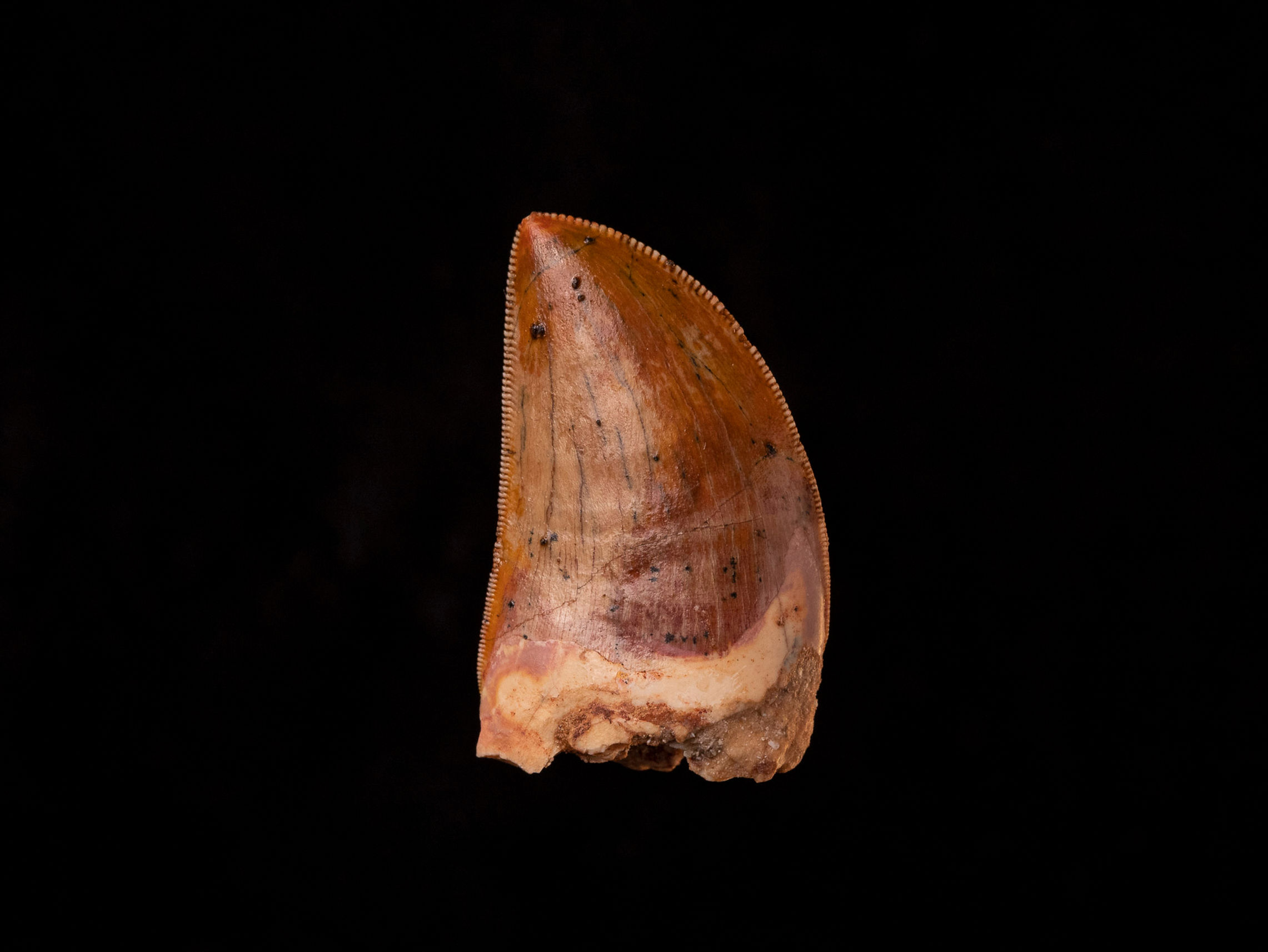

Carcharodontosaurus saharicus (Depéret & Savornin, 1927)
Era: Mesozoic
Period: Cretaceous
Age: Cenomanian-Turonian (100.5 - 89.8 Ma)
Formation: Ifezouane (Red sand)
Origin: Kem-Kem valley,  Begaa, near Taouz
Region: Drâa-Tafilalet
Province: Errachidía, Morocco
Coordinates: 30°53'53.7"N 3°51'48.6"W
Measurements: 34 x 21 x 10 mm / 1.34" x 0.83" x 0.39"
Weight: 5.9 g / 0.21 oz
Description: Carnivorous dinosaur tooth in good condition, 100% natural, without repairs. Exceptional preservation.


Information: The Kem Kem Beds are located in southeastern Morocco, near the border with Algeria. They constitute one of the most important fossil assemblages of the African Cretaceous and are formed by a succession of fluvial and deltaic deposits accumulated between the Late Albian and the Cenomanian.
Contrary to popular belief, Kem Kem does not correspond to a single site or a single ecosystem. It is a geological group composed of several sedimentary formations that represent different environments and periods in time. Among these, the Ifezouane and Gara Sbaa formations stand out, constituting the lower part of the sequence, as well as the Aoufous and Douira formations, which represent more recent levels.


The fossils recovered at Kem Kem include an extraordinary diversity of vertebrates, including sharks, bony fish, coelacanths, turtles, crocodiles, pterosaurs, dinosaurs, and birds. Among the dinosaurs found at Kem Kem are some of the largest known terrestrial predators, such as Spinosaurus aegyptiacus and Carcharodontosaurus saharicus.
However, not all the animals found at Kem Kem necessarily coexisted at the same time. Many come from different stratigraphic levels within the sedimentary sequence, which records several million years of geological history. Therefore, Kem Kem should be understood as an exceptional window into the ecosystems of Cretaceous Africa rather than as representing a single biological community.


Among the most spectacular finds at Kem Kem are the remains of some of the largest known predatory dinosaurs, such as Spinosaurus aegyptiacus and Carcharodontosaurus saharicus.


Carcharodontosaurus saharicus was one of the largest predatory dinosaurs that inhabited North Africa during the Cretaceous period. It belonged to the Carcharodontosaurid group, a family of large theropods characterized by their massive skulls and laterally compressed teeth with fine serrations. Its name means "shark-toothed lizard," referring to the resemblance of its teeth to those of some predatory sharks.
The Kem Kem Beds have yielded some of the most important known remains of this gigantic predator. However, as with many African dinosaurs from the Cretaceous period, the fossil record of Carcharodontosaurus remains fragmentary and consists of isolated remains from different stratigraphic levels.


Carcharodontosaurus saharicus was part of a lineage of large African predators that also includes Carcharodontosaurus iguidensis, a species described from material found in Niger. Both represent some of the largest known theropods from the African continent and are outstanding examples of the evolutionary success achieved by carcharodontosaurids during the Cretaceous period. For this reason, the teeth identified as belonging to Carcharodontosaurus saharicus are highly prized fossils among collectors, as they belong to one of the largest known terrestrial predators and one of the most iconic dinosaurs of the Cretaceous African ecosystems.


This piece will travel insured in a safety package to arrive in perfect condition.
